Conducted by the Feminist
Majority Foundation
Tracy Sefl, PhDc
Amy Hennessy, BA
Elizabeth Gavrilles, MFA
Jennifer Jackman, PhD
Released January 19, 2000
KEY FINDINGS
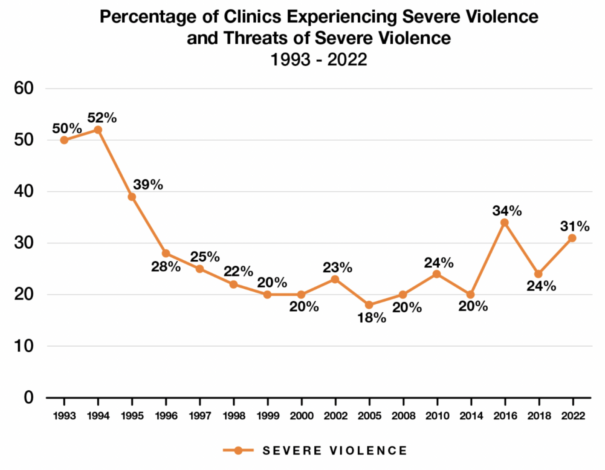
• One in five clinics experienced severe
anti-abortion violence in 1999. The percentage of clinics reporting one or
more types of severe anti-abortion violence (including death threats, stalking,
bombings, arsons, blockades, invasions, chemical attacks, bomb threats, and
arson threats) declined slightly from 22% in 1998 to 20% in 1999.[1] [2]
• Fewer clinics were free from violence in
1999, reversing a trend from previous years.
Anti-abortion violence
and harassment appears more widely distributed, as the percentage of clinics
reporting no violence, vandalism, or harassment has declined from 64% in 1998
to 54% in 1999. For the first time, the
gap between the percentage of clinics experiencing no violence and those facing
moderate violence has narrowed. Moreover,
the percentage of clinics experiencing high levels of concentrated
anti-abortion violence is relatively unchanged at 5% in 1999 compared with 4%
in 1998.
• Vandalism at clinics has more than
doubled; bomb threats are slightly up. A major increase in vandalism is detected. Over one-third of clinics (34%) reported one or more forms of vandalism, a
figure more than doubled from 16% in 1998.
In 1999, 13% of clinics were the target of bomb threats, which is a
small increase from 11% in 1998.
• Measured in this survey for the first
time, 18% of clinics report harassment via the Internet or Web. Abortion clinic providers are open targets in cyberspace. With ever-increasing access to computer
technology, clinic staff, providers, and patients have become vulnerable to
this form of harassment, which may include divulging personal information such
as home address and phone numbers, or advocating the targeting of specific
abortion providers.
• Anthrax threat attacks were prevalent in
1999, with 11% of clinics affected. Clinics in every region of the country have
been subjected to these disruptive threats (newly measured in the 1999 National
Clinic Violence Survey), all of which have thus far proved to be hoaxes. Additionally, in early January 2000 alone,
over thirty clinics in twenty-two states have also received anthrax threats.
· All levels of law
enforcement received higher “excellent” ratings in 1999, with local law
enforcement yielding the largest net increase. This year, 52% of clinics rated local law enforcement as
excellent, up 15% from 1998. Federal
law enforcement excellent ratings increased from 21% to 35%, a 14% increase. Excellent ratings for state law enforcement
also went up, rising 8% in 1999 to 20%.
In addition, clinics reported much stronger enforcement of buffer zones
and injunctions. The percentage of
clinics that identified “strong” enforcement of their buffer zones nearly
tripled from 14% to 39% in 1999.
• Lower levels of violence are again
associated with higher law enforcement response ratings. For example, of those clinics that rated
local law enforcement response as “excellent,” only 16% experienced high
violence. Conversely, one-third of
clinics rating local law enforcement poorly were subjected to high levels of
anti-abortion violence.
1999 NATIONAL CLINIC VIOLENCE SURVEY REPORT
METHODOLOGY
The seventh annual
National Clinic Violence Survey measured anti-abortion
violence and
harassment over the past twelve months.
This survey is one of the
most
comprehensive studies of anti-abortion violence and harassment directed at
clinics,
patients,
health care workers and volunteers in the United States and includes abortion
providers of various
organizational affiliations as well as independent clinics.
In September 1999,
surveys were mailed to 839 clinics in the United States. The
universe of
clinics was compiled by the Feminist Majority Foundation’s National Clinic
Access
Project. Follow-up telephone and fax
contacts were made from mid-October to
December. Three hundred and sixty abortion providers
responded, yielding a response
rate of 43%.[3]
Participants in this survey were assured that their individual responses
would remain
confidential.
This sample of 360 clinics includes clinics and private doctors’ offices in 47 states and the District of Columbia. (See Appendix A for a list of respondents by state.) Types of facilities in this sample included non-profit (41%), for-profit (36%) and doctor’s offices (23%).
While 62% of the
clinics were affiliated with Planned Parenthood and/or the National Abortion
Federation, the remaining 38% were unaffiliated with either organization. The majority of facilities are free-standing
(64%) and have uncovered parking lots (84%).
On-site, volunteer clinic escorts assist patients at 29% of all
reporting facilities.
The percentage of
clinics’ practices devoted to abortion services ranges from 10% or less (23% of
all clinics) to over 76% (45% of all clinics). Virtually all facilities (99%) offer a variety of other women’s
reproductive health care services.
These include birth control services (96%), pregnancy counseling (90%),
emergency contraception (84%), adoption counseling and referral (67%), cancer
screening (67%), and HIV/AIDS testing (60%).
Methotrexate, a
method of early medical abortion, is administered at 27% of
responding clinics. Also, clinics’ interest in offering mifepristone (formerly known
as RU-486) once it becomes available in the United States continues to grow (up
3% to 65% in 1999). Consistent with
previous reports, non-profit clinics are most enthusiastic about offering
mifepristone (75%).
1999
NATIONAL CLINIC VIOLENCE SURVEY REPORT
RESULTS
ONE IN FIVE CLINICS EXPERIENCE SEVERE
ANTI-ABORTION VIOLENCE
Compared to 1998,
which began with a fatal bombing at an abortion clinic and ended with the
murder of a doctor who performed abortions, 1999 seemed like a relatively quiet
year at our nation’s women’s health clinics.
Yet, even with the combined and ongoing efforts of the pro-choice
community and local, state, and federal law enforcement, the overall level of
violence directed at abortion clinics remained essentially the same as in
1998. In 1999, as shown in Chart 1
below, one in five clinics suffered severe anti-abortion violence.
The percentage of
clinics reporting one or more types of severe violence (which includes
bombings, arsons, blockades, invasions, chemical attacks, death threats, stalking,
bomb threats, and arson threats) dropped slightly from 22% in 1998 to 20% in
1999.[4]
While anti-abortion violence plagued clinics across the United States,
ten states bore the brunt of the severe violence: Alabama, Arizona,
California, Florida, Michigan, New York, North Carolina, Pennsylvania, Texas,
and Virginia (Appendix B).
This decline is
part of a trend over the past five years.
In 1994, with anti-abortion extremists emboldened by the January 1993
U.S. Supreme Court decision in Bray, et al. v. Alexandria Women’s Health
Clinic, et al.,[5] severe clinic violence reached an all-time
high of 52%. However, the sustained
efforts of pro-choice mobilization combined with the federal Freedom of Access
to Clinic Entrances (FACE) Act and U.S. Supreme Court decisions in Madsen v.
Women’s Health Center[6] and NOW, et al. v. Scheidler, et al.[7] sent a strong deterrent message to anti-abortion extremists in
1994. Overall levels of severe violence
dropped significantly to 39% in 1995. Since
1996, when severe violence was reported at 28%, there continues to be a small
and slow decline in severe violence.
Yet 20% of
clinics still suffering from anti-abortion violence indicates an enduring
problem at our nation’s women’s health clinics.

HIGH
VIOLENCE STILL CONCENTRATED; FEWER CLINICS FREE FROM VIOLENCE
The 1999 National Clinic Violence Survey data
reflect the greater dispersion of harassment, intimidation and violence
throughout the overall clinic population, with more clinics affected by at
least one or two types of violence (Chart 2).
As well, high levels of violence remain concentrated on a small
percentage of clinics (5%) in 1999, akin to 4% in 1998.
And for the first
time since 1995 in the National Clinic Violence Survey, the gap between those
clinics experiencing no violence and those experiencing moderate and high
violence has narrowed. This gap is
revealed in the analysis of indexed variables measuring the total number of
violent and harassing tactics all clinics experienced. This indexed measure combines tactics of
violence, intimidation and harassment.
This measure was then divided into three levels: clinics experiencing no
violence (zero types), moderate violence (1-2 types) and high violence (3 or
more types).[8]
Reversing a
trend from previous years, this year’s findings reveal that the gap between
clinics facing moderate violence and no violence has diminished (Chart 2). In every survey prior to 1999, more and more clinics were reporting no
violence, peaking with 64% of clinics free from violence in 1998. In 1999, however, that trend noticeably
reversed as the percentage of clinics free from violence declined to 54%. In 1998, 64% of clinics reported no
violence, harassment, or intimidation and 32% experienced moderate levels – for
a gap of 32%. The gap this year between
clinics facing moderate and no violence narrowed considerably to 13%, as 54% of
clinics reported no violence and 41% reported moderate levels of violence. This redistribution is illustrated in
comparing the “no” and “moderate” violence trend lines in Chart 2.

As severe violence continues its slight but steady decline, the frequency of severe threats remains near-constant overall. As in 1998, this year slightly less than one in five clinics (18%) received bomb, arson, or death threats. More bomb threats were reported than in 1998, rising slightly from 11% to 13% in the current reporting period (Chart 3). Death and arson threats remained stable between 1998 and 1999, at 6% and 1% respectively.
Clinics where abortion constitutes more than three-fourths of all services (45% of all clinics), however, receive the bulk of these threats. Notably during this reporting period, clinics whose primary service is abortion received 61% of bomb threats and just over half of all death threats (52%).
Chart 4 provides a
longitudinal view of changes in frequency of types of violence from 1997 to
1999. In addition to the increases in
vandalism, bomb, death, and arson threats noted above, other interesting
findings are illustrated. Chemical
attacks and gunfire have both declined from 1998, whereas stalking, break-ins,
blockades and invasions are slightly higher. From 1998 to 1999, chemical attacks and gunfire both declined
from approximately 1% to less than 1%.
There were small increases in reports of stalking, break-ins and invasions. Stalking and break-ins both increased from
5% in 1998 to 6% in 1999; facility invasions went up from 2% to 3%. Reports of blockades, while small in total
number, more than doubled from 2% to 5%.

Chart Note:
In 1999, arsons and bombings measures included attempted events as well as
actual events.
Over one-third of all clinics (34%) were subjected to one or more forms of vandalism, making vandalism the most frequently reported type of anti-abortion harassment or intimidation. This finding has more than doubled since 1998, when only 16% of all clinics experienced one or more forms of vandalism. Anti-abortion extremists continue to barrage clinics with an increasingly widespread vandalism campaign. Their methods are diverse, attacking building structures, adjacent property, and even staff members’ personal property.
The increase in clinic vandalism is also reflected in another manner: the previously reported finding that fewer clinics are free from violence (see Chart 1). Anti-abortion extremists have broadened their campaign against clinics and more clinics were vulnerable to vandalism in 1999 compared to 1998.
When examining the multiple forms of vandalism directed at clinics, graffiti remains the most commonly reported tactic (31%), though this is a decline from 38% of vandalized clinics in 1998. Despite that decline, graffiti is the most widely reported form of structural vandalism, as reports of broken windows and paint splattering have declined from 1998.
New in this year’s questionnaire, clinics were asked to report any garbage dumpster tampering at their facility. Seventeen percent (17%) of vandalized clinics reported this form of vandalism. Phone call and line tampering has increased, occurring at one-fourth (25%) of vandalized clinics, compared to 18% of vandalized clinics in 1998.
Notably, 27% of vandalized clinics provided open-ended responses as to additional forms of vandalism directed at their clinics. These supplemental tactics included tampering with septic tanks and building ornaments, broken glass strewn in clinic driveways, malicious corruption of outdoor power sources, torn siding, slashed tires on staff members’ cars, and the smearing of human excrement on exterior walls.
The seventh annual
National Clinic Violence Survey measured Internet and Web-based harassment for
the first time. Data suggest that
abortion providers are open targets in cyberspace, with 18% of clinics
reporting this form of harassment.
Such harassment may include divulging personal “profiles” including home
addresses and telephone numbers; death threats; or even advocating murder of
specific abortion providers. This
harassment occurs in various electronic forms: on Web sites, in Internet chat
rooms, and through email. Recourse for
such forms of harassment is complicated by the often-veiled identities of
persons posting such information.
The most infamous example of this tactic was anti-abortion extremist Neal Horsley’s “Nuremberg Files” Web site[9], where, amidst graphics of dripping blood, hundreds of abortion providers and abortion rights advocates’ names were listed. Many of those persons’ names were hyper-linked to personal information profiles including home addresses and type of car driven. This form of harassment has been found to constitute “true threats,” and in Planned Parenthood v. American Coalition of Life Activists, a jury ordered several anti-abortion extremists to pay $107.5 million in damages to abortion providers who had been targeted and threatened by the defendants.
Unlike bold and
prominent “WANTED” posters distributed in communities with abortion providers’
names, photos, and addresses (posters which 6% of clinics report appearing in
their communities in 1999), the evolving nature of cyberspace may leave clinic
staff and abortion providers unaware that cyber-threats are even being
circulated.
Thirty-nine
clinics nationwide (11%) received threatened anthrax attacks in this year’s
reporting period. Anthrax, an infectious and potentially fatal
bacterial disease, has no indication of exposure: there is no cloud, color,
smell, taste, or effective treatment for unvaccinated victims.[10]
Clinics in the Midwest and Northeast received the bulk of the threats,
measured for the first time in the 1999 National Clinic Violence Survey. When asked to compare the frequency of
anti-abortion violent tactics from 1999 to 1998, clinics report that the
frequency of threatened anthrax attacks increased 13%, much more than all other
tactics.
Clinics who
receive threatened anthrax attacks are subjected to extensive evacuation,
testing, and safety procedures. Such
attacks are also disruptive to the larger community, evidenced in a recent
anthrax threat at a Toledo OH abortion clinic where law enforcement officials
closed a ten-block area. Although the
FBI reports that a spate of letters received in 1999 contained only a sticky
substance or dark powder, clinic staff and abortion providers are nonetheless
disrupted by the necessary evacuation, decontamination, and testing
procedures.
In the first two
weeks of January 2000, over thirty clinics in twenty-two states have also
received anthrax threats.[11]
Investigations are ongoing.
Overall, Clinic Staff and Administrators
Prove Resilient to Campaign of Violence
The
percentage of clinics reporting staff resignations as a result of anti-abortion
violence increased. Following a violent 1998, with a fatal clinic
bombing in Birmingham AL and the murder of Dr. Barnett A. Slepian in his
Amherst NY home, 10% of clinics reported staff resignations due to
anti-abortion violence, an increase from 5% of clinics in 1998. Of those few clinics reporting
violence-related resignations, 32% lost a physician, 29% lost a receptionist,
26% lost a lab technician, 23% lost a counselor, and 20% lost a nurse. Clinic administrators proved most resilient,
with only 6% resigning.
These
resignations can be understood in the broad context of severe clinic violence
and persistent harassment. Indeed, the
longitudinal trend displayed below (Chart 5) reflects increases in staff
resignations that correspond with horrific acts of violence like the murders of
doctors, clinic staff, and volunteers in 1993 and 1994.
Within this
overall picture, as well, is a strong relationship between violence-related
staff resignations and the level of violence at a given clinic. In 1999, 22% of clinics experiencing high
violence lost staff members; in fact, twice as many clinics experiencing high
violence lost staff compared with clinics not subjected to high violence. In the wake of a year that saw a fatal
clinic bombing and a physician murdered in his own home, staff vulnerability at
“high violence” clinics, while intuitive, is disturbing.
More
clinics were protected by buffer zones in this year’s reporting period, nearly
one-third (114 clinics, 32%) compared with 27% of clinics in 1998. Buffer zones are areas determined by courts,
legislatures, or municipal officials in which distance is specified between
demonstrators and their intended targets.
Buffer zones may apply to clinic facilities as well as staff members’
homes. This year, ten clinics reported
home buffer zones for staff members or physicians, compared with 1998, when
only five clinics reported such protections.
More
clinics conferred positive law enforcement ratings for their buffer zones and
injunctions in 1999 than in 1998. A
significant portion of clinics (35%) reported that their buffer zones and
injunctions were strongly enforced.
This finding is dramatically higher than 1998, when buffer zones were
strongly enforced at only 14% of clinics and injunctions strongly enforced at
11% of clinics.
Clinics’
perceptions of stronger buffer zone and injunction enforcement are also
reflected in lowered “poor” ratings. Fewer
clinics in this reporting period reported weak or no enforcement of buffer
zones and injunctions compared to 1998.
In 1999, 23% of clinics rated their legal protections as weakly or not
enforced. In 1998, buffer zones were
weakly or not enforced at 28% of clinics, and injunctions weakly or not
enforced at 36% of clinics.
Nine percent (9%)
of clinics turned to the legal system for legal remedies other than buffer
zones, consistent with 10% of clinics seeking legal remedies in 1998. Temporary restraining orders and permanent
injunctions were the most frequently sought remedies, with eighteen (5%) and
fourteen clinics (4%) seeking such measures respectively.
Nearly half of
those clinics with buffer zones or injunctions (46%) believe that these legal
protections have prompted improved law enforcement responses to anti-abortion
violence and harassment at their facilities.
In addition to legal remedies sought, legal victories in this reporting period were also analyzed. Thirteen clinics won temporary restraining orders (4%), five won preliminary injunctions (1%), and nine won permanent injunctions (3%). Twenty-nine clinics (8%) were awarded money damages as a result of anti-abortion activities, though less than one in five of those clinics (17%) have yet to collect monies owed to them.[12]
Even though, for the most part, clinics have not been able to collect judgments, they have not given up and are still pursuing anti-abortion extremists. At the end of
1999, four of the twelve anti-abortion defendants in the high-profile Planned Parenthood v. ACLA filed for bankruptcy just prior to their federal court-ordered depositions in an effort to avoid disclosing financial information in the post-judgment phase of the lower court proceeding. Increasingly, anti-abortion extremists are using bankruptcy filings in an effort to avoid paying damage awards.
Thirty-nine clinics (11%) contacted law
enforcement officials to report potential violations of FACE. These numbers have essentially doubled from
the 20 clinics contacting law enforcement regarding potential FACE violations
in 1998 (Chart 6). Although the number
of clinics making FACE-related law enforcement contacts has increased, clinics
report that the handling of such contacts by law enforcement officials has
declined.
Several
indices of authorities’ responses to FACE complaints suggest that more
aggressive investigations and prosecutions are necessary. Of those clinics initiating contact with
officials, the majority (66%) did not receive clear direction for
pursuing their complaints. This is an
increase from 1998, when 55% of clinics did not receive clear directions from
officials. Fifteen percent (15%) of clinics
were advised that authorities would not prosecute their cases, a slight
increase from 11% in 1998. A greater
percentage of clinics were advised to refer complaints to local law enforcement
this year (45%) compared with 30% in 1998.
Moreover, in relatively few cases (23%) did federal officials even
conduct official interviews with involved parties.

The percentage of
clinics with FACE violations that reported federal officials had initiated
criminal FACE actions was cut in half from 10% in 1998 to 5% in 1999. A slight decrease – from 10% to 8% - occurred in the proportion of clinics
reporting that civil FACE actions had been initiated. These 1999 reports reverse a trend between 1997 and 1998, where
more civil and criminal FACE actions were initiated.
The role of law
enforcement is an important variable both in the continued, although slight,
decline of severe violence and the improved ratings of legal protections like
buffer zones and injunctions. The
combined efforts of pro-choice advocacy on behalf of clinics, along with
increased judicial and legislative penalties against anti-abortion extremists
are contributing to law enforcement’s increasingly high-quality responses to
clinics’ needs.
Clinics were asked
to rate their overall experience with the law enforcement response to clinic
violence and harassment in the reporting period. All levels of law enforcement received more “excellent” ratings
in 1999 than in 1998 (Chart 7), with local law enforcement yielding the largest
net increase. In 1999, 52% of
clinics rated local law enforcement as excellent, up 15% from 1998. Federal law enforcement excellent ratings
increased from 21% to 35%, a 14% increase.
Excellent ratings for state law enforcement went up 8% in 1999 to
20%.

An additional measure of law
enforcement response examines a comparison of this reporting period to
1998. Most clinics report that local,
state, and federal law enforcement response has remained the same. Yet notably, several clinics said that local
and federal law enforcement improved this year, 14% and 15% respectively. Both of these ratings reflect increases from
1998, up 1% for local and 7% for federal law enforcement. Nine percent of clinics (9%) said state law
enforcement had improved, up from 6% in 1998.
This
study also examines the type of interactions that clinics have with law
enforcement officials. As local law
enforcement officials provide the first response to the majority of
anti-abortion incidents, clinics necessarily report the most contact with this
level of law enforcement (80%). Just
over half of all clinics (53%) contacted federal law enforcement officials and
32% contacted state officials. The
majority of clinics have designated contact persons or liaisons with local
(65%) and federal (60%) law enforcement officials.
Seventy-four
percent of clinics (74%) report that law enforcement officials had visited
their facilities for a variety of reasons, including responding to anthrax
threats or complaints, or in the course of an investigation. Overall, clinics most frequently report that
local law enforcement has visited their clinic to discuss security issues
(51%).
Nine
percent (9%) of clinics reported arrests on-site, with misdemeanors being the
most frequently reported type of arrest (82%).
This is consistent with arrest rates in 1998 (9%). Eleven clinics also noted that anti-abortion
arrests occurred off-premises (i.e., at a staff member’s home or
neighborhood). These off-premises
arrests were also largely misdemeanor arrests (64%). Only 3% of these arrests, both on- and off- premises, resulted in
criminal prosecution. This figure is
slightly lower than both 1997 and 1998, where 4% of all arrests resulted in
criminal prosecutions.
LOWER
LEVELS OF VIOLENCE AGAIN ASSOCIATED WITH BETTER LAW ENFORCEMENT RESPONSE
As
reported in 1998, the quality of local and federal law enforcement is
associated with the level of violence at clinics nationwide. In 1999, 185 clinics rated their local law
enforcement as excellent. Of these
clinics, 39% were free from violence and only 16% reported high violence. Few clinics rated their local law enforcement
as poor. Nonetheless, of those 19
clinics, 32% experienced high violence compared with 21% who were free from
violence.
Federal law
enforcement was rated as excellent by 111 clinics. Of those clinics, 29% were free from violence, compared to 17%
who faced high violence. Similar to
local law enforcement ratings, very few clinics rated federal law enforcement
as poor. Of those 11 clinics, the
majority (45%) faced high anti-abortion violence compared to 27% who faced
none.
These findings indicate
that excellent law enforcement response was more likely to be associated with
no or low violence. Poor law
enforcement ratings appeared to be related to higher levels of violence.
These
relationships largely mirror the law enforcement/violence relationship in the
1998 findings. In 1998, of clinics
reporting “excellent” federal law enforcement response, only 6% experienced
high violence. Of clinics describing
poor federal law enforcement response, 20% had high levels of violence.
Despite the fact
that there were no anti-abortion fatalities in 1999, one in five clinics
remains plagued by severe violence.
This level of severe violence at abortion clinics remains essentially
unchanged, at 20% of all clinics in 1999, down slightly from 22% in 1998. The trend for declines in categories of
severe violence continues, though the declines are modest. These declines are offset by slight
increases in types of severe violence like bomb threats, death threats,
blockades, and stalking.
The war of
attrition against clinics continues. As
in 1998, a small percentage of clinics (5%) is again besieged with multiple,
and often simultaneous, types of violence as anti-abortion extremists continue
to try to force clinics out of business.
Notably, our
survey further revealed that the percentage of clinics experiencing no violence
has declined, meaning that fewer clinics are free from anti-abortion violence,
harassment, and intimidation. In 1999,
54% of clinics were free from violence, an appreciable decline from 64% in
1998. Moreover, the gap between clinics
experiencing no violence and those experiencing moderate levels of violence has
narrowed. Given the stability of the
percentage of clinics facing high violence, this narrowed gap suggests a
greater dispersion of anti-abortion violence, intimidation, and harassment at
clinics nationwide.
Another new and
disturbing finding in the 1999 National Clinic Violence Survey is the
prevalence of Internet and Web harassment by anti-abortion extremists. Eighteen percent of clinics (18%) reported
cyberspace harassment and threats.
These cyberspace threats may take many forms, from privacy-invading
profiles of physicians to overt death threats against specific abortion
providers. This form of harassment is
alarming for providers both because the identities of persons making threats
are often veiled, and because the nature of cyberspace allows instantaneous
diffusion among anti-abortion extremists nationwide.
An additional new
finding in 1999 was that 11% of clinics nationwide were the targets of anthrax
threat letters. These threats (which,
to date, have been hoaxes) have the potential for wide disruption to clinics
and larger communities. The frequency
of these hoaxes – including over thirty incidents in the first weeks of January
2000[13] – suggests that anthrax hoaxes are an
increasingly preferred tactic for anti-abortion extremists. Recent security advisories from the Feminist
Majority Foundation, Planned Parenthood Federation of America, and the National
Abortion Federation have aided clinic administrators in intercepting several of
these hoax letters.
In
this context of violence – and following a year that included a fatal clinic
bombing and the murder of a physician in his home – staff resignations as a
result of anti-abortion violence doubled in 1999, up from 5% to 10%. Of those clinics with violence-related
resignations, those facing high levels of violence were twice as likely to lose
a staff member or physician.
Perhaps the most encouraging
findings of our study are the increasingly high ratings that clinics awarded
law enforcement responses to clinic violence.
This year, all levels of law enforcement (local, state, and federal)
received notably higher “excellent” ratings than in 1998. This finding demonstrates that the role of
law enforcement is a vital element in the continued slight decline of severe
anti-abortion violence. Not only has
the law enforcement response to violence improved, but 80% of clinics also
reported regular contact with local law enforcement officials. This suggests that the interrelationships of
clinics and law enforcement are valuable in combating anti-abortion
violence.
Moreover, this
survey shows a relationship between the quality of law enforcement response and
the level of violence at clinics. In
one telling finding, only 16% of clinics that rated local law enforcement
response as “excellent” faced high levels of anti-abortion violence. Conversely, one in three clinics that rated
local law enforcement as “poor” experienced high violence.
This year’s data
also showed that 32% of clinics now have legal protections such as buffer zones
and injunctions (a 5% increase from 1998), and that the strong enforcement of
such protections dramatically increased from 14% in 1998 to 40%.
Although the
overall law enforcement response to clinic violence has demonstrably improved,
our survey contained less optimistic news about specific law enforcement
responses to clinics’ claims of potential FACE violations. Twice as many clinics contacted law
enforcement officials to report potential violations of FACE (the 1994 Freedom
of Access to Clinic Entrances Act), forty clinics in 1999 compared with twenty
clinics in 1998. Yet clinics reported
that the law enforcement follow-up to these FACE-related contacts has
declined. Two out of three clinics did
not receive clear direction for pursuing their complaints, up from 55% in
1998. Our 1999 findings show a reversed
trend from 1997 and 1998, in that fewer civil and criminal FACE actions have
been initiated by federal law enforcement.
The diminishing
trend line of anti-abortion violence at women’s health centers is
encouraging. But neither the law
enforcement community nor the pro-choice community can become complacent. One-fifth of women’s clinics besieged by
severe anti-abortion violence is an unacceptable level of violence for a civil
society or for providing accessible health care to all American women.
APPENDIX
A
Number
of Respondents by State
Alabama 08
Alaska 02
Arizona 10
Arkansas 04
California 50
Colorado 06
Connecticut 08
Delaware 02
Florida 33
Georgia 06
Idaho 01
Illinois 08
Indiana 06
Iowa 05
Kansas 03
Kentucky 01
Louisiana 03
Maine 03
Maryland 06
Massachusetts 07
Michigan 17
Minnesota 04
Mississippi 02
Missouri 03
Montana 05
Nebraska 02
Nevada 02
New Hampshire 03
New Jersey 07
New Mexico 01
New York 28
North
Carolina 13
North Dakota 02
Ohio 15
Oklahoma 01
Oregon 06
Pennsylvania 12
Rhode Island 04
South Dakota 01
Tennessee 06
Texas 19
Utah 02
Vermont 04
Virginia 10
Washington 11
West Virginia 02
Wisconsin 04
District of
Columbia 02
TOTAL 360
APPENDIX B
One of the eight participating Alabama clinics reported that its facility was the target of an attempted arson. One clinic reported that members of their staff or physician(s) were stalked. Likewise, one clinic reported that members of their staff or physician(s) received death threats. One clinic received an anthrax threat.
One of the ten participating Arizona clinics reported that it was invaded. Three clinics reported anthrax threats.
Of the 50 participating California clinics, four clinics reported blockades at their facilities. Three clinics were the targets of attempted arson. Two clinics reported that members of their clinic staff or physicians(s) were stalked. Three clinics received death threats targeted at clinic staff or physician(s). One clinic received an anthrax threat.
Three of the thirty-three participating Florida clinics reported blockades at their facilities. Three clinics also reported that their facilities were invaded. One Florida clinic reported an attempted bombing. One clinic reported an attempted chemical attack. One clinic reported that members of their clinic staff or physican(s) were stalked.
One of the seventeen participating Michigan clinics reported that their facility had been invaded. One clinic reported an attempted arson. One clinic reported death threats against clinic staff or physician(s). One clinic received an anthrax threat.
One of the twenty-eight participating New York clinics reported a blockade in front of their facility. One clinic reported that their facility had been the target of an attempted arson. Three clinics reported that members of their clinic staff or physician(s) were stalked; two clinics reported having received death threats against clinic staff or physician(s). Two clinics received anthrax threats.
On March 13, 1999, a bomb partially exploded outside of one of the thirteen participating North Carolina clinics. One clinic was blockaded. One clinic reported that members of their staff or physician(s) received death threats. One clinic received an anthrax threat.
Three of the twelve participating Pennsylvania clinics reported that members of their clinic staff or physician(s) were stalked. One clinic reported an attempted bombing. One clinic reported receiving death threats against clinic staff or physician(s). Two clinics received anthrax threats.
Two clinics of the nineteen participating Texas clinics reported blockades at their facilities. One clinic reported being invaded by anti-abortion extremists. Two clinics were the targets of attempted bombings. One clinic reported that members of their staff or physician(s) were stalked; one clinic received an anthrax threat.
Three of the ten participating Virginia clinics reported that members of their staff or physician(s) were stalked; two clinics reported death threats against their staff or physician(s). One clinic was blockaded. One clinic received an anthrax threat.
APPENDIX C
STATE LOCATION(S)
AL Birmingham, Tuscaloosa
CT Manchester
DC District of Columbia
DE Wilmington
FL Naples
GA Atlanta, Savannah
IL Chicago, Peoria
IN Ft. Wayne, Portland
KY Louisville
ME Portland
MI Detroit
NC Asheville
NJ Morristown, Hackensack
NY Bronx, Manhattan
OH Toledo
PA Pittsburgh
RI Providence
SC Columbia
TN Knoxville
VA Roanoke, Richmond
VT Williston
WI Milwaukee