|
|
|

Table of Contents
Summary
The 1994 Feminist Majority Foundation's Clinic Violence Survey
revealed that anti-abortion violence during the first seven months
of 1994 continued to plague the lives of health care workers who
provide abortion services. The key findings of our survey include:
- violence directed at abortion clinics and health care workers
remained at essentially the same high levels as in 1993;
- anti-abortion extremists are increasingly turning to death threats
as their primary strategy;
- blockades, invasions, chemical attacks and home picketing decreased
since 1993;
- following the murders of Dr. Bayard Britton and clinic escort
James Barrett, death threats escalated;
- fewer clinic staff resigned this year than in 1993 as a result
of anti-abortion violence;
- increases in clinic violence are related to poor law enforcement
response; and
- law enforcement response to clinic violence generally has improved,
but enforcement of the 1994 Freedom of Access to Clinic Entrances
Act during its first five months has been limited.
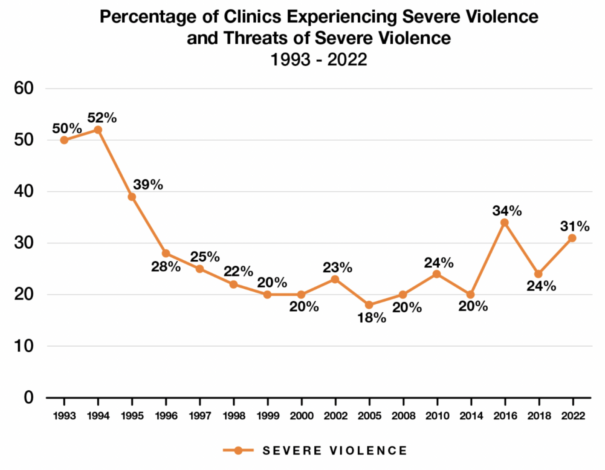
Of the clinics surveyed, 51.9% experienced one or more types
of violence, including death threats, stalking, chemical attacks,
bombings and bomb threats, invasions, arson and arson threats, and
blockades. Last year, 50.2% of clinics reported one or more of these
types of violence. When additional forms of violence such as home
picketing, gunfire, and vandalism were considered this year, 66.7%
of clinics reported one or more types of violence.
Death threats were the most frequently reported type of violence.
Of the clinics, 24.8% indicated that members of their staff had
received death threats. More clinics reported that death threats
had increased since 1994 than any other form of violence; 14% of
clinics experienced an increase in death threats during the first
seven months of 1994. Death threats again increased significantly
after the July slayings in Pensacola; 16.6% of clinics reported
an increase in death threats after the murders of Dr. Britton and
Barrett. Moreover, the survey found that death threats were directed
at non-profit clinics, which are generally more economically vulnerable,
in significantly higher numbers than at for-profit clinics or private
doctor's offices.
Anti-abortion violence resulted in fewer clinic staff resignations
in the first seven months of 1993 than in 1994. Of clinics responding
to the 1994 survey, 8.9% had at least one staff member quit because
of clinic violence, compared with one-third of clinics in 1993.
The survey found that clinic violence imerils not only abortion
access, but also a wide ranize of low-cost health care services.
Of the clinics in the survey sample, 94.9% provide services in addition
to abortion such as cancer screening, birth control, infertility
treatment, vasectomies, tubal ligation, and adoption services.
The survey also measured the responses of local, state, and federal
authorities to reports of anti-abortion violence. Enforcement
of the Freedom of Access to Clinic Entrances (FACE), an act
passed by the U.S. Congress to protect clinics from anti abortion
violence, during the first few months since its enactment was extremely
imited. Fifty-two clinics reported FACE violations to law enforcement
officials. One quarter of these clinics were told that federal officials
would not prosecute under FACE or were directed to local law enforcement
agencies. Many of these clinics said that law enforcement response
was inadequate even when their reports of FACE violations elicited
visits from federal law enforcement officials and clear directions
on how to pursue FACE claims.
In the wake of recent U.S. Supreme Court decisions upholding clinic
buffer zones and allowing clinics to sue under federal conspiracy
laws, and after FACE passage, clinics reported some improvement
in the response to clinic violence by local, state, and federal
law officials. The survey also found that clinics did not often
seek assistance from state and federal authorities. Clinics relied
primarily on local law enforcement for assistance in contending
with anti-abortion extremist activities. Yet local authorities
were the most unlikely or unable to provide adequate protection
for clinics.
Poor law enforcement response, in fact, appears to have a direct
relationship to violence at clinics. Statistically significant
relationships were found between law enforcement response and changes
in the level of specific types of violence since 1993.
The following sections examine important findings from the 1994
survey related to the types and levels of anti-abortion violence,
the rise in death threats, clinic staff losses, the disruption of
women's health services, anti-abortion violence since the July murders,
and law enforcement effectiveness.

Table of Contents
Copyright 1995, The Feminist Majority Foundation and New
Media Publishing Inc.
|