KEY FINDINGS
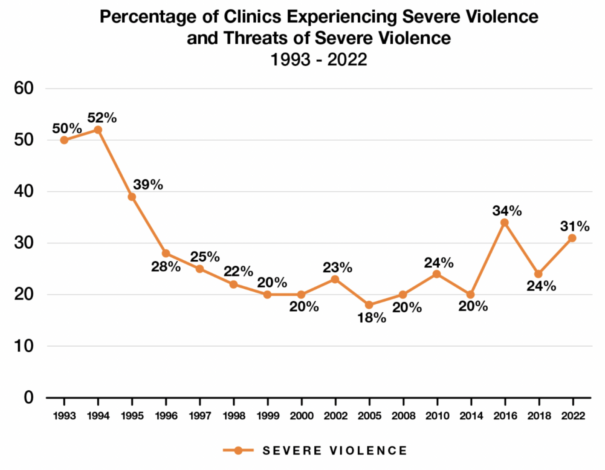
- Levels of clinic violence in 1995
declined substantially. In 1995, 38.6% of clinics experienced
one or more of the most severe forms of clinic violence, including
death threats, stalking, bomb threats and bombings, chemical attacks,
blockades, invasions, and arson and arson threats. This rate
is down significantly from 51.9% of clinics in 1994 and 50.2%
in 1993. The proportion of clinics experiencing one or more types
of violence grew to 55.8% when home picketing, vandalism, and
gunfire also were tabulated. In 1994, 66.7% of clinics experienced
at least one of the twelve types of violence.
- For the first time, in every category
of violence, more clinics in 1995 reported decreases than increases
in incidents. The smallest net decreases, however, were in reports
of death threats and stalking.
- Violence directed at individual
physicians and clinic staff members continued at unacceptably
high levels. Almost one in five clinics (17.1% ) reported death
threats in 1995; one in five (20.3%) reported home picketing;
and one in ten (10.6%) said clinic staff had been stalked.
- Violence directed at physicians
and clinic staff has taken its toll. Clinic staff resignations
as a result of anti-abortion violence remained at 1994 levels,
with almost one in ten (9%) of clinics having lost clinic staff
for this reason. The majority (60.7%) of violence-related staff
resignations occurred as a result of the December 30, 1994 murders
of clinic workers in Brookline, Massachusetts.
- One in five clinics reported violations
of the Freedom of Access to Clinic Entrances Act to federal law
enforcement officials, representing an increase from 16.5% in
1995. The majority (54.8%) of clinics reporting FACE violations
were directed by federal authorities to seek assistance from local
and state laws and law enforcement officials.
- Decreases in clinic violence corresponded
with law enforcement response. Local, state, and federal law
enforcement officials won higher marks from clinics for their
response to anti-abortion violence in the 1995 than in 1994.
The greatest improvement in law enforcement response was seen
at the local level, where 34.5% of clinics reported enforcement
efforts had improved.;
- Clinic demands for legal remedies
from the courts experienced mixed success. In 1995, 15.2% of
clinics sought judicial relief from clinic violence, but less
than half (46.8%) actually obtained the legal remedy sought. Over
one-third (35.5%) of clinics
are now protected by a buffer zone or civil injunction.

Table of Contents
Copyright 2000, The Feminist Majority Foundation and New Media
Publishing Inc.